
Key takeaways
- Repair failed glazing, seals or window joinery first. A shutter cannot fix a draught coming through a damaged window.
- Consider a honeycomb blackout blind for another insulating layer when the room also needs complete darkness.
- The historical test below measured heat transfer through one glass-and-frame assembly, not a household energy-bill saving.
Before choosing a shutter material, check where the cold is coming from. Glass that feels cold and a draught through a damaged frame are different problems. Closed shutters add a layer in front of the window, but a gap in the window itself still needs repair.
Are shutters good for insulation?
Yes, when they fit well and are closed. Historic England tested several treatments on one traditional single-glazed timber sash window. Its glass-and-frame calculation showed a 58% reduction in heat transfer with closed shutters. The U-value fell from 4.3 to 1.7 W/m²K. This figure excludes heat lost through air leakage. The report examines draughts separately. See the Historic England sash-window research for the complete test method and results.
Draughts can matter more than the glass. The researchers estimate that, in a typical house, air leakage would have caused over 60% of the heat lost through this window before it was repaired. That is why the window itself comes first.
The table compares treatments on that same window. Low-emissivity secondary glazing produced a reported 58% reduction, and the combined glazing-and-shutter arrangement produced 62%.
The study demonstrates why an internal covering can be worth considering on a traditional sash window. It does not certify our current shutters or predict a household bill saving. Nor does it establish an acoustic rating or a summer room-temperature reduction. Use it to understand the principle, then choose a layout that works with your window.
Historic England: heat transfer through the glass and frame
Controlled sash-window test
| Test assembly | Whole-window U-value | Glass/frame heat-loss reduction |
|---|---|---|
| Window as found | 4.3 W/m²K | Baseline |
| Heavy curtains | 2.5 W/m²K | 41% |
| Well-fitting shutters | 1.7 W/m²K | 58% |
| Plain roller blind | 2.7 W/m²K | 38% |
| Reflective roller blind | 1.9 W/m²K | 57% |
| Honeycomb blind | 2.1 W/m²K | 51% |
| Low-emissivity secondary glazing | 1.8 W/m²K | 58% |
| Low-emissivity secondary glazing and shutters | 1.6 W/m²K | 62% |
These are the reported results for one traditional single-glazed timber sash assembly, with U-value uncertainty of ±0.3. Air-leakage losses were assessed separately. The percentages are not a guarantee for current shutters or a reduction in total losses including draughts.
Do shutters reduce heat loss on double-glazed windows?
Yes, although the measured reduction was smaller than in the single-glazed sash test above. In testing backed by the British Blind and Shutter Association (BBSA), internal plantation shutters reduced heat loss through the glass of a modern double-glazed, low-emissivity window by up to 28%. That was one tested setup. It is not a measured result for our shutters or a forecast saving on your energy bill.
Use the result that matches your window. Historic England's 58% came from a single-glazed sash, so do not apply it to double glazing. For a modern double-glazed window, the BBSA result is the closer guide.
Whichever glazing you have, the extra layer comes from closing well-fitting panels and louvres. The material, style and fit advice below applies in the same way.
Which shutter material provides the best thermal insulation?
We recommend Polycomposite shutters when insulation is a priority. Its waterproof construction also makes it suitable for kitchens and bathrooms, where the material must cope with moisture as well as the cold window. Hardwood shutters remain useful in dry rooms when lighter panels, a custom colour or a solid-panel design are more important. Closed Hardwood shutters also add an internal layer.
That recommendation is not a measured saving or an acoustic rating for your home. Polycomposite contains metal reinforcement, but that construction detail alone does not establish how much heat or sound a complete installation will stop.
The Hardwood and Polycomposite comparison explains the weight, finish and room choices. Those differences can matter more than insulation on an opening that needs large, light panels.
Which shutter style gives the most complete thermal coverage?
Choose full-window coverage if insulation is the main reason for adding shutters. Full-height panels cover the opening from top to bottom. Tier-on-tier also covers it fully when both tiers are shut. Cafe-style shutters leave the upper glass uncovered, so they do not create the same complete layer.
Solid Hardwood panels need to be opened to admit daylight; there are no louvres to tilt. Louvred shutters let you adjust light and privacy while the panels stay closed. If you use the room through the day, choose the control you will use as well as the coverage you want when everything is shut.
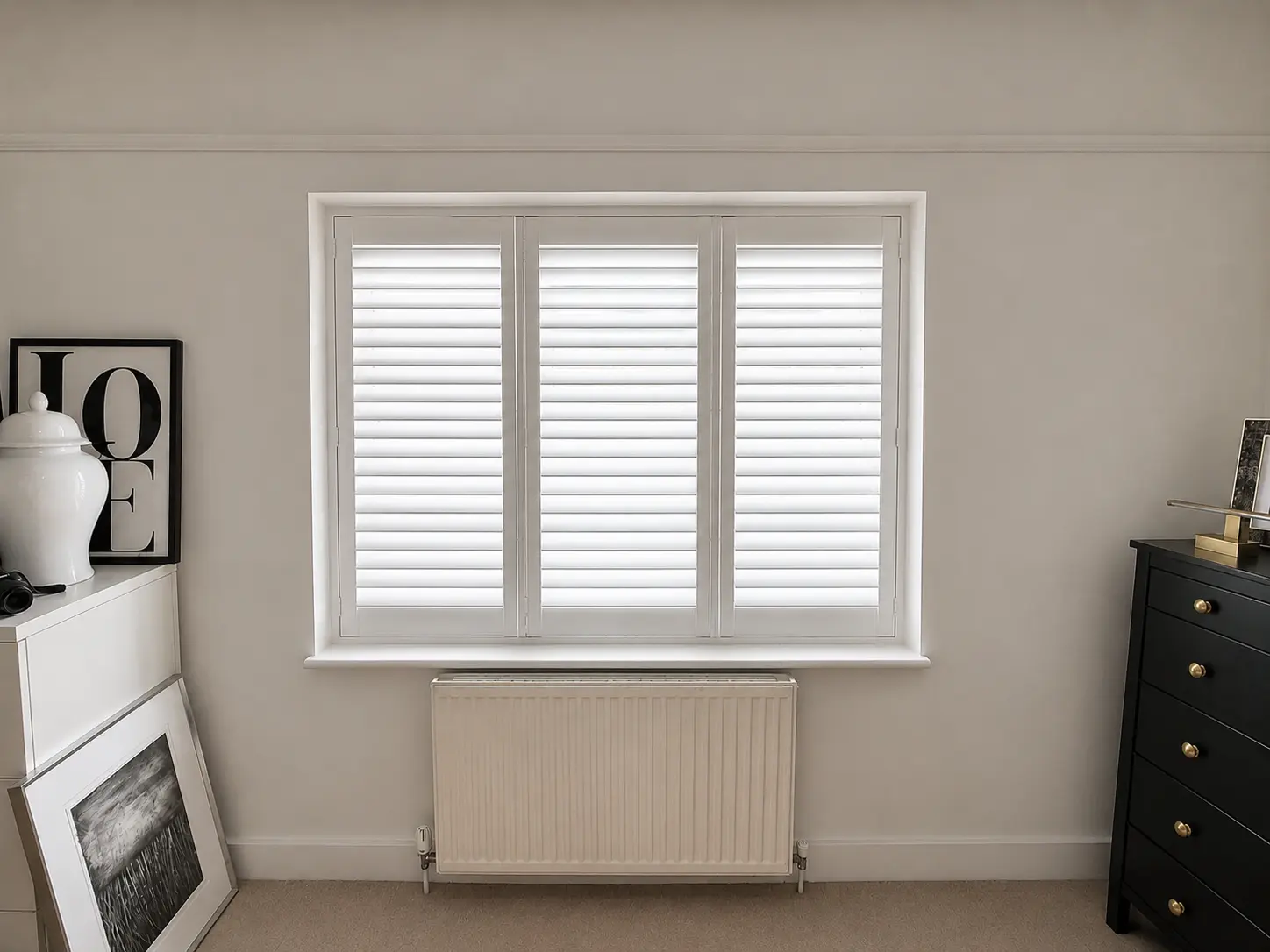
The bedroom installation pictured at the top of this guide shows full-height coverage in Epsom. Our Epsom shutters page explains the local survey and fitting service. The photograph illustrates the layout, not a measured thermal result.
A midrail or split control lets you adjust the upper and lower louvres within a full-height panel. It does not create separately opening panels. Tier-on-tier does, which is useful if you want to open the upper tier while keeping the lower tier shut for privacy. Compare these movements in the plantation shutter style guide.
Thermal shutters vs thermal blinds
On the single-glazed Historic England test window, closed shutters and a reflective roller blind gave the two largest reductions of any single covering. Against the shutters' 58% through the glass and frame, the test's reflective roller blind managed 57%, its honeycomb insulating blind 51% and a plain roller blind 38%. Heavy curtains gave 41%. The tested blinds were not our products. The report rounds the results and gives an uncertainty of ±0.3 in the U-values, so read the top results as broadly similar.
The BBSA-backed tests on a modern double-glazed window included blinds as well. A roller blind with zipped side channels reduced heat loss through the glass by up to 33%, and a honeycomb blackout blind in a perfect-fit frame by up to 32%, against up to 28% for internal plantation shutters. On that window, the best blinds did better than the shutters. These are not measured results for our shutters or blinds.
The practical difference is daytime control. A blind gives its layer only while it is lowered, which also covers the view. With shutters you can tilt the louvres for light and privacy during the day, then close the panels and louvres fully for the insulating layer in the evening.
You do not have to choose one or the other. If the room also needs blackout, a honeycomb blackout blind can sit behind suitable shutters. The cells hold air within the fabric and add another layer across the opening. This can combine night-time darkness with adjustable shutter privacy during the day. On standard windows we fit this blind with shutters rather than as a standalone thermal blind, and the blind page explains the integrated and retrofit arrangements. Our blackout and insulation guide explains how construction and fit affect the result.
Why do window condition, fit and panel closure matter?
A sound window is the starting point. Arrange repairs for water ingress, rotten timber, failed glazing or gaps around the frame before the final shutter measurement. Repair work can change the opening, so measuring afterwards also avoids ordering shutters around dimensions that are about to change.
Fit then determines whether the panels and louvres can actually close. A projecting handle can stop a louvre turning. At a bay corner, one panel can catch its neighbour. Both faults leave an opening in a layer that was intended to close, even if the material itself is suitable.
In winter, open the panels or tilt the louvres when sunshine is warming the room, then close both panels and louvres as daylight fades. Keep window vents accessible and open the shutters whenever you need to use the window.
The bay-window shutter guide explains how those corners are planned. If you are deciding whether to change the glazing first, read shutters versus double glazing for the different jobs each treatment does.
For a sound window where warmth and daytime privacy both matter, Shutters Design can help you choose full-window coverage and a material suited to the room. At a home survey, we check that the panels can close properly and whether there is room for a blackout blind behind them. You can then compare a complete fitted specification, not just an insulation claim.