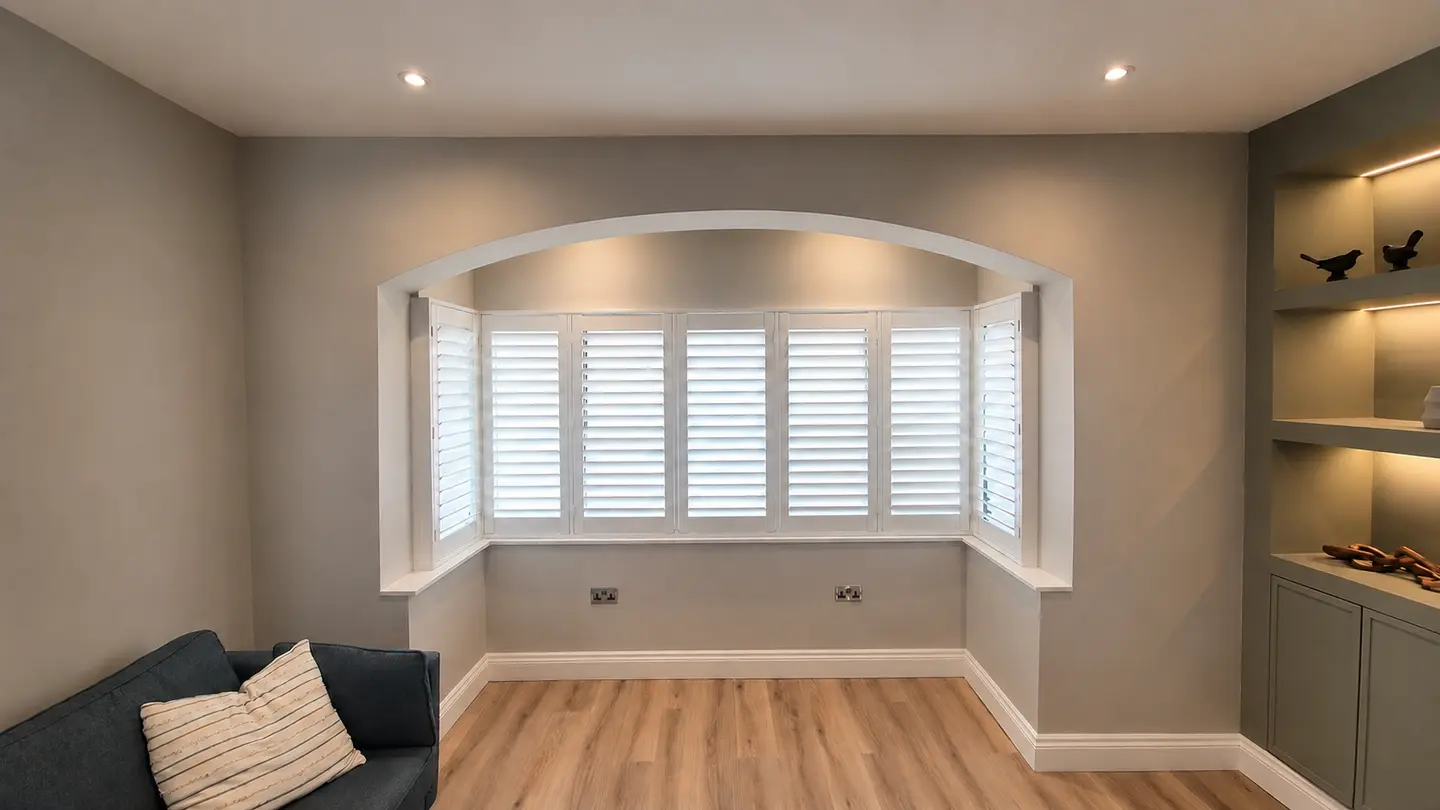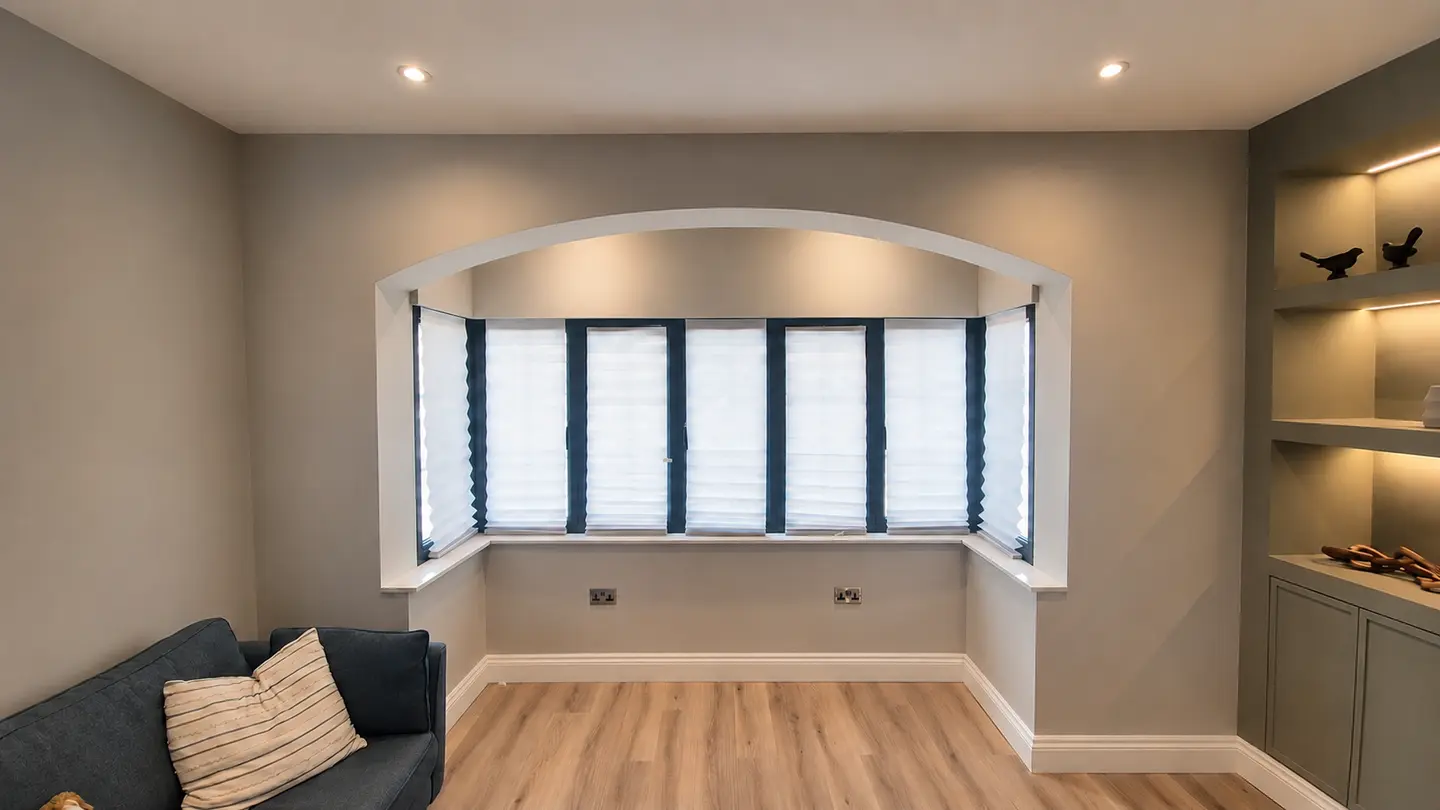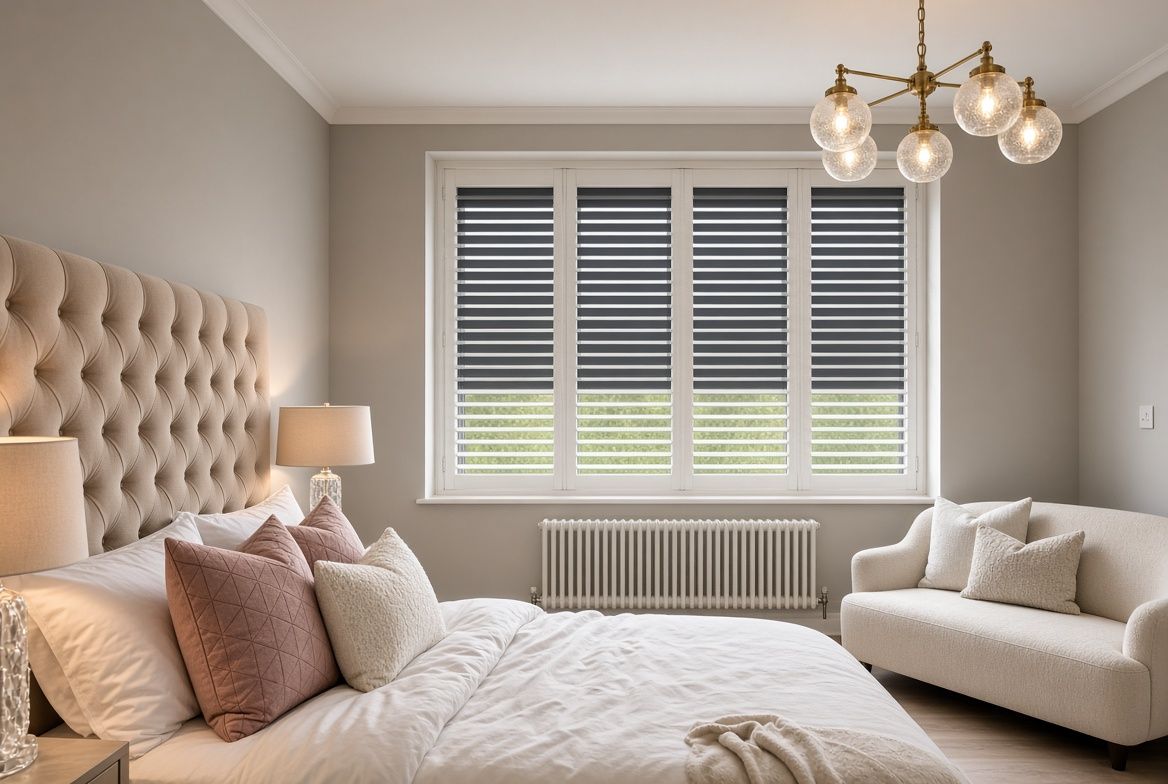
Blackout Blinds Behind Plantation Shutters: How the Two Layers Work Together
Adding a blackout blind behind plantation shutters is usually associated with achieving complete darkness. But there is another reason the combination is worth considering: the blind adds a second layer between the room and the window, which can help reduce heat loss in winter and unwanted solar heat gain in summer.
The effect comes from the way the two layers work together, rather than from the blackout fabric alone.
Quick answer
A plantation shutter already creates an internal barrier in front of the glazing. A cellular or honeycomb blackout blind adds another layer, including air-filled cells within the blind itself.
When both are closed, the window has a more layered internal treatment:
room → shutter → air space → cellular blackout blind → glazing → outside
In winter, this additional layering can help reduce heat transfer from the warm room towards the colder window.
In summer, closing both treatments can reduce the amount of sunlight and solar energy reaching the room.
The result is not a replacement for good glazing or a guarantee of a particular energy saving. It is a more controlled thermal and light environment at the window.
Key takeaways
A blackout blind behind shutters does more than create darkness; it adds another layer across the window.
Cellular or honeycomb construction creates enclosed air spaces that can contribute to thermal resistance.
In winter, the combination can help reduce heat loss through the treated window.
In summer, closing the blind and shutters can reduce unwanted solar heat entering the room.
The thermal effect depends on the glazing, frame, installation, gaps and how the coverings are operated.
A blackout blind does not correct failed glazing, damaged seals or structural draughts.
Existing compatible plantation shutters can often be upgraded with a retrofit blackout blind without replacing the shutters.
The strongest result comes from treating the shutter and blackout blind as one window system rather than two unrelated products.
In this guide
01 Why does a blackout blind affect thermal performance?
02 How does the combination work in winter?
03 Can it help keep a room cooler in summer?
04 Why does a cellular blackout blind matter?
05 Can blackout blinds be retrofitted behind existing shutters?
06 What determines the actual performance?
Why does a blackout blind affect thermal performance?
The important distinction is between blocking light and controlling heat.
A conventional blackout blind is primarily designed to prevent light passing through the fabric. A cellular blackout blind has an additional physical characteristic: its honeycomb structure creates enclosed air pockets within the blind.
Air trapped within a suitable cellular structure provides additional resistance to heat transfer.
This is why cellular shades are recognised in building-energy research as a form of interior window treatment that can reduce heat loss during colder conditions and solar heat gain during warmer conditions.
The blind therefore contributes in two different ways.
First, it blocks virtually all visible light when fully closed.
Second, its construction introduces another thermal layer between the interior space and the glazing.
The distinction is important because maximum blackout and thermal performance are related, but they are not the same measurement.
A room can be completely dark without necessarily being thermally efficient.
The advantage of the cellular blackout system is that it can address both requirements.
How does the combination work in winter?
During winter, the inside of the home is warmer than the outside.
The window is therefore one of the places where heat can escape.
Closing the plantation shutters creates an additional internal layer in front of the glazing. Closing the cellular blackout blind adds another layer and reduces the direct exposure of the room to the colder window surface.
The effect is not that the blind somehow generates heat.
It is that less heat can be transferred as easily through the treated window assembly.
This is particularly relevant at night, when curtains and shutters are normally closed and the temperature difference between indoors and outdoors can be greatest.
The Department of Energy's research into cellular shades identifies their ability to reduce heat loss through windows as one of their principal energy benefits.
The precise improvement, however, depends on the complete window.
A modern double-glazed unit with good seals starts from a very different position from an older single-glazed sash window.
For that reason, it would be misleading to attach one universal percentage to every installation.
Can it help keep a room cooler in summer?
Yes, but the mechanism is different.
During summer, the principal issue can be solar heat gain rather than heat escaping from the room.
Sunlight passes through the glazing and can heat the room, particularly where windows face strong afternoon or midday sun.
Closing the plantation shutters reduces direct solar exposure.
Closing the blackout blind creates another barrier.
This can reduce the amount of solar radiation reaching the interior and therefore help limit unwanted heat gain.
The effect is particularly relevant to:
bedrooms exposed to early morning sunlight;
south- and west-facing windows;
rooms with large areas of glazing;
nurseries where temperature and darkness both matter;
home offices affected by glare;
media rooms where daylight control is important.
There is an important distinction here.
The winter benefit is principally about retaining heat; the summer benefit is principally about limiting heat entering the room.
The same two products therefore perform different functions according to the season.
Why does a cellular blackout blind matter?
Not all blackout blinds have the same thermal construction.
A conventional flat blackout fabric primarily provides light control.
A cellular or honeycomb blind is constructed differently. The fabric forms cells that trap air within the structure.
That gives the blind a second function beyond blocking light.
The U.S. Department of Energy has identified cellular shades as one of the more effective interior window-treatment options for reducing heat loss, while research into window attachments has also shown that the position, construction and fit of an internal shade influence its thermal performance.
For a shutter installation, this creates an interesting combination:
The shutter provides the architectural, privacy and adjustable daylight layer.
The cellular blackout blind provides the darkness and additional insulating layer.
Neither product needs to replace the other.
What happens when both are closed?
This is where the concept becomes easiest to understand.
With the shutters open, the window can behave much as it normally would.
With the shutters closed, the room gains the additional barrier provided by the shutter.
With the blackout blind also closed, another layer is introduced immediately behind it.
The system can therefore be adjusted according to what the room requires.
Daytime
Shutters open or louvres adjusted for daylight and privacy.
Bright summer periods
Shutters closed, with the blackout blind lowered where additional solar control is required.
Winter evenings
Both layers closed to create the additional internal barrier.
Night-time
Blackout blind lowered for maximum darkness and privacy.
This flexibility is one of the strongest reasons to combine the two systems.
Can blackout blinds be retrofitted behind existing shutters?
In many cases, yes.
This is particularly useful for homeowners who already have good plantation shutters but have discovered that the room still receives too much light at night.
Replacing the shutters is not necessarily the answer.
A compatible blackout blind can potentially be installed behind the existing shutter frame, leaving the shutters themselves untouched.
The blind operates independently.
During the day, the shutter can continue to provide the appearance, privacy and adjustable light control that the homeowner already enjoys.
At night, the blackout blind can be lowered behind it.
The suitability of a retrofit depends on the existing shutter configuration, available depth, frame arrangement and operating clearances, so it should be assessed at the window rather than assumed from photographs alone.
What determines the actual thermal performance?
There is no single number that applies to every shutter-and-blackout installation.
The important variables include:
The glazing
Single, double and triple glazing have very different starting levels of thermal performance.
The window frame
The condition and construction of the frame can be just as important as the glass.
Air leakage
A blackout blind cannot compensate for a significant draught through a failed seal or damaged window.
The distance between layers
The air space between the glazing, blind and shutter affects how heat moves through the assembly.
The blind construction
A cellular blackout blind provides a different thermal barrier from a conventional flat blackout fabric.
The fit
Large gaps around a window treatment can reduce the effectiveness of an otherwise well-designed system.
How the treatments are used
A closed system behaves differently from one left open. Seasonal and daily operation therefore matters.
This is why a thermal claim should always be attached to a particular installation rather than presented as a universal saving.
Is this the same as improving the window itself?
No.
This distinction is important.
A blackout blind does not replace a failed sealed unit, repair a rotten timber frame or eliminate a structural draught.
If the window itself is defective, that problem should be addressed first.
The blackout blind and plantation shutter then work as internal window treatments, improving control of light, privacy and heat transfer around an otherwise suitable window.
This is also why a proper survey matters.
The objective is not simply to determine whether a blind will fit.
It is to understand how the complete window currently performs and whether adding another layer is appropriate.
What about complete darkness?
Thermal performance is only half of the reason for choosing this combination.
Closed plantation shutters provide excellent daylight control, but small amounts of light can remain around louvres, panels or the geometry of the window.
A properly specified blackout blind addresses that remaining light.
The result is particularly useful where darkness itself is important rather than simply reduced daylight.
That includes bedrooms, children's rooms, shift workers' bedrooms and home cinema or media rooms.
The blackout blind therefore solves a problem that the shutter alone was not specifically designed to solve.
And, at the same time, it adds another layer at the window.
The practical advantage: one window, several levels of control
The strongest reason for combining plantation shutters with blackout blinds is not that either product suddenly becomes more effective.
It is that they perform different jobs without competing with each other.
Requirement
Plantation shutters
Cellular blackout blind
Adjustable daylight
Excellent
Limited when lowered
Privacy
Excellent
Excellent when closed
Complete darkness
Very high
Designed for maximum blackout
Winter heat retention
Additional internal layer
Additional insulating layer
Summer solar control
Yes, when closed
Yes, when lowered
Daytime ventilation
Yes
Depends on operation
Architectural appearance
Strong
Remains largely concealed behind shutter
Retrofit potential
Existing installation
Often possible behind compatible shutters
The result is a window treatment that can change with the room rather than forcing the room to adapt to one fixed solution.
What is the most sensible way to specify the combination?
If complete darkness is the only objective, the blackout blind should be specified primarily for its light-blocking performance.
If year-round comfort is also important, the construction and fit of the blind become equally relevant.
For an existing shutter installation, the first question is whether there is sufficient space and a suitable configuration for a retrofit.
For a new shutter installation, the two treatments can be considered together from the beginning.
That approach is particularly useful where the room has large glazing, strong solar exposure or a specific need for darkness.
The aim should not be to add as many layers as possible.
It should be to add the right layer for the problem the window actually has.
Frequently Asked Questions
Will a blackout blind make my room warmer in winter?
It can help reduce heat loss through the treated window when closed, particularly when combined with plantation shutters. The actual effect depends on the glazing, frame, fit and construction of the blind.
Will it make the room cooler in summer?
Closing the shutters and blackout blind can reduce unwanted solar heat entering through the window. The result depends strongly on the window's orientation, glazing and exposure to direct sunlight.
Does a cellular blackout blind insulate better than a normal blackout blind?
Its honeycomb construction creates enclosed air spaces, giving it a thermal function that a simple flat blackout fabric does not provide in the same way.
Can I add a blackout blind to shutters I already have?
Often, yes. Compatible existing plantation shutters can potentially have a blackout blind retrofitted behind them without replacing or modifying the shutter itself. The available space and shutter configuration need to be checked first.
Do I need blackout blinds if I already have plantation shutters?
Not necessarily. If the shutters provide enough darkness for your room, an additional blind may not be necessary. The blind becomes particularly useful when the room needs near-complete darkness or when an additional layer of window control is desirable.
Is the blackout blind mainly for bedrooms?
No. Bedrooms are the most obvious application, but the combination can also be useful in nurseries, media rooms, home offices and rooms with strong solar exposure.
A second layer with a different purpose
Plantation shutters and blackout blinds should not be thought of as competing window treatments.
The shutter controls the window throughout the day.
The blackout blind provides another level of darkness and introduces another layer between the room and the glazing when required.
In winter, that layer can help retain warmth.
In summer, it can help limit unwanted solar heat.
At night, it can provide the darkness that shutters alone may not achieve.
The result is not simply a darker window. It is a more controllable one.
If you already have plantation shutters and want to know whether a blackout blind can be retrofitted behind them, or you are planning a new shutter installation and want both functions from the beginning, Shutters Design can assess the window and recommend the appropriate configuration.
A good window treatment should solve the actual problem — not simply add another product.