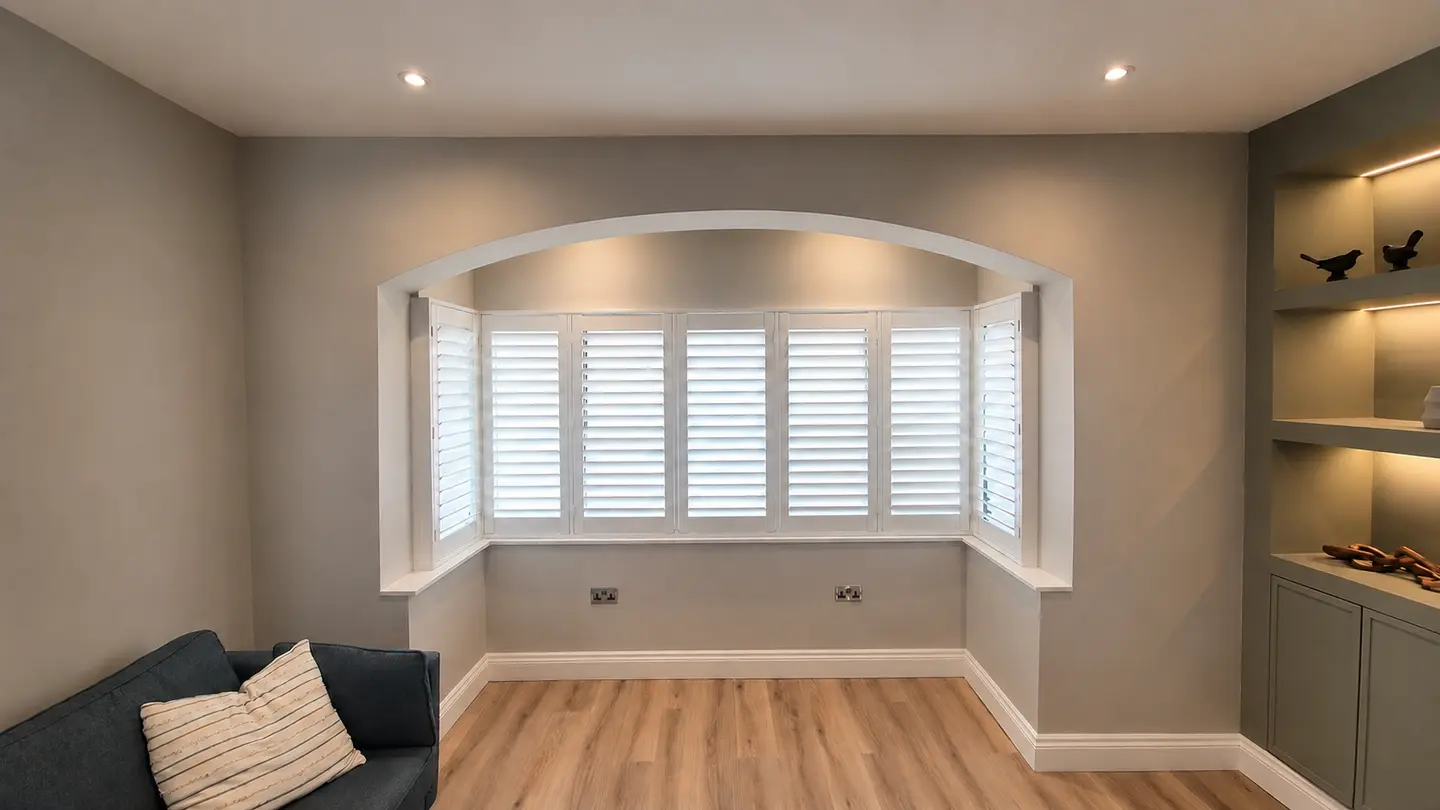
Patio Door Shutters: Choosing the Right Material and Opening System
Patio doors and very large windows need more than a shutter that simply looks good when it is closed.
The size of the opening, the way the panels need to move, the available space inside the room and the material used can all affect whether the finished installation is practical to live with.
That is why choosing shutters for a patio door is really two separate decisions:
What should the shutter be made from? How should the panels open and move?
The material and the opening system solve different problems. Understanding the difference makes it much easier to choose the right configuration.
[INTERNAL – Materials Guide: plantation shutter materials]
The three materials: Hardwood, Polycomposite and Security Aluminium
Shutters for patio doors and large openings can be manufactured in different materials, each with a different set of characteristics.
Hardwood shutters
Hardwood is genuine timber and remains a popular choice where the natural appearance of real wood is important.
It is relatively light compared with some composite constructions, which can become particularly relevant when larger shutter panels are involved.
For a large opening, reducing panel weight can make a difference to the way the shutters operate and to the hardware required.
Hardwood is generally most appropriate for dry interior environments where the natural character of timber is part of the design.
Materials Guide: Hardwood plantation shutters
Polycomposite shutters
Polycomposite shutters are designed around durability and resistance to moisture.
This makes them particularly useful in kitchens, bathrooms, humid conservatories and other areas where condensation, steam or occasional splashes may be an issue.
They can also be a practical choice for large glazed areas where durability and ease of maintenance are priorities.
Materials Guide: Polycomposite shutters
The important point is that Polycomposite is not simply a different colour or finish. It is a different material construction intended for different practical requirements.
Security Aluminium shutters
Security Aluminium is a different proposition again.
The emphasis is on a robust metal construction and the possibility of incorporating security-focused hardware and locking arrangements.
This can make aluminium particularly relevant for vulnerable patio doors, large accessible windows, holiday homes, second residences or properties that may be left unoccupied for periods of time.
Read more: Security Aluminium shutters
The important distinction is that aluminium itself does not automatically make a shutter secure. The overall result depends on the construction, frame, fixing method, panel design and locking system.
For that reason, security should always be considered as a complete shutter system rather than simply a choice of material.
Read article about: Aluminium Security Shutters
How should the panels open?
Once the material has been considered, the next question is how the shutter panels should move.
This is where three terms commonly appear:
Tracked
Bi-fold
Bi-pass or sliding
They are related, but they do not describe exactly the same thing.
A useful way to understand them is:
Tracked describes how the panels are supported and guided.
Bi-fold describes how panels fold.
Bi-pass describes how panels slide past one another.
This distinction becomes particularly important when choosing shutters for patio doors.
Read more about Shutter Styles
Tracked shutters
A tracked shutter uses a track system to guide the panels across the opening rather than relying entirely on conventional side hinges.
This makes tracked shutters particularly useful where the opening is wide and the panels need to move clear of the glazed area.
They can be used for:
Patio doors
French doors
Wide windows
Floor-to-ceiling glazing
Large openings in extensions
Certain room-divider applications
The major advantage is not simply appearance. It is control over where the shutter panels go when they are opened.
Instead of having a large panel swinging deep into the room, the track allows the configuration to be designed around the available space.
[INTERNAL – Existing Patio Door Article: patio door shutter installation]
Bi-fold shutters
With a bi-fold configuration, shutter panels are hinged together and fold as a group.
This can be particularly useful where a wide opening needs to be exposed without requiring every panel to swing independently into the room.
Depending on the configuration, panels may fold together and move to one side, both sides, or another predetermined position.
Bi-fold therefore describes the folding action of the panels.
It does not necessarily mean that the system is separate from tracking. A bi-fold shutter can operate on a track.
This is why the terms tracked and bi-fold should not automatically be treated as competing alternatives.
Read more about Bi-fold shutters
Bi-pass shutters
Bi-pass, sometimes described as a sliding configuration, allows panels to move past one another.
Instead of folding together, one panel can slide behind another, allowing the shutter arrangement to occupy less space in front of or behind the opening.
This can be useful where the available wall space or room layout makes folding less suitable.
A bi-pass arrangement can also allow panels to be brought towards one or both sides of an opening, depending on the track configuration.
In other words, bi-pass is about panels passing behind each other rather than folding together.
Tracked vs Bi-fold vs Bi-pass: what is the difference?
The simplest comparison is:
Configuration
How the panels move
Particularly useful for
Tracked
Panels are guided along a track
Wide openings and large glazing
Bi-fold
Panels fold together
Wide patio doors where the opening needs to clear
Bi-pass
Panels slide behind one another
Openings where folding or projection is less suitable
But there is an important detail.
These descriptions can overlap.
A patio-door shutter may be tracked and bi-fold, because the track guides the folding panels.
Likewise, a shutter may be tracked and bi-pass, because the track allows the panels to slide past one another.
So the real design question is not simply:
“Do I need tracked or bi-fold shutters?”
It is:
“How should the panels move, and where do I want them to go when the shutters are open?”
That is a much more useful starting point.
What if the patio doors themselves are bi-fold?
This is one of the situations where shutter design needs particularly careful planning.
The shutter does not necessarily have to copy the movement of the doors behind it.
A property may have bi-folding patio doors, for example, but the shutters could be designed as a separate tracked and bi-fold configuration, depending on the opening, frame arrangement and available space.
The shutter panels need to work independently of the door mechanism while still allowing comfortable access to the handles and the full opening.
During a proper survey, details such as:
door configuration
handle position
frame depth
panel width
hinge or track position
opening direction
available wall space
clearance around the opening
all become relevant.
This is why large patio-door shutters should be designed around the actual opening, rather than selected from a photograph or a standard configuration.
What about sliding patio doors?
Sliding patio doors create a different set of requirements.
The glass doors already move horizontally, so the shutter needs to provide practical access without interfering with the door operation.
A tracked or bi-pass shutter configuration can be particularly appropriate because the shutter panels can also move horizontally rather than projecting significantly into the room.
The exact arrangement depends on the number of door leaves, the direction in which they open and the space available beside or behind the opening.
Read more about Bi-fold shutters
The same principle applies to very large windows
Tracked, bi-fold and bi-pass shutters are not limited to patio doors.
The same principles can be applied to very large windows where conventional hinged shutter panels would become cumbersome or would occupy too much room when opened.
This can include:
Floor-to-ceiling windows
Large picture windows
Glazed extensions
Conservatories
Orangeries
Wide architectural openings
For these installations, the question is often less about the window itself and more about how much of the glazing the homeowner wants to expose when the shutters are open.
If the objective is to achieve maximum access to the glass, panel movement becomes an important part of the design.
Where do the shutters go when they are open?
This is one of the most useful questions to ask before choosing a configuration.
A shutter can look perfect when closed and still be inconvenient if its open position has not been properly considered.
For example:
If the panels swing into the room: How much floor space do they occupy?
If the panels fold: Where will the folded panels sit?
If the panels slide: Is there sufficient space for them to pass behind one another?
If the shutters are tracked: Where does the track need to run, and where will the panels stack?
The best configuration is therefore not necessarily the one that looks most impressive in a photograph.
It is the one that continues to work properly when the shutters are open.
Can different materials be combined with different opening systems?
Yes.
Material and movement should be considered as two separate layers of the design.
For example, a large patio opening might use:
Hardwood + tracked bi-fold configuration
where lower panel weight and natural timber appearance are important.
Another installation might use:
Polycomposite + tracked configuration
where durability and moisture resistance are higher priorities.
A property where security is a major consideration could instead require:
Security Aluminium + a suitable tracked or sliding configuration
with the locking and fixing system designed as part of the overall installation.
The important point is that there is no universal material/configuration combination that is right for every patio door.
The correct specification depends on the opening, environment, operation and priorities of the property.
What about a holiday home or second residence?
Large patio doors can be particularly significant in a holiday property or second home.
When the property is occupied, the shutters can provide privacy, light control and a finished architectural appearance.
When it is empty, however, the requirements can change.
A robust shutter system with appropriate locking can form part of a broader security strategy, particularly around accessible patio doors and large ground-floor windows.
Security Aluminium may therefore be worth considering where robustness is a priority.
Read about us – Trustpilot
However, the decision should still be based on the complete specification rather than material alone. The frame, fixing, locking arrangement and installation all matter.
Read about us – Checkatrade
Which shutter configuration is right for your patio door?
There is no single answer because the correct solution depends on several practical questions.
1. How wide is the opening?
The wider the opening, the more important panel weight, panel width and movement become.
2. How much of the opening needs to be exposed?
If you want the shutters to move substantially clear of the glass, a tracked or folding configuration may offer more flexibility than conventional hinged panels.
3. How much room is available beside the opening?
This can influence whether panels should fold, slide behind one another or stack in a particular position.
4. How do the patio doors themselves operate?
Sliding, French and bi-folding doors all create different practical requirements.
5. Is moisture resistance important?
Bathrooms, kitchens, conservatories and humid environments may favour Polycomposite.
[INTERNAL – Materials Guide: moisture-resistant plantation shutters]
6. Is low panel weight important?
Large hardwood panels can be attractive where natural timber and relatively low weight are priorities.
7. Is security a major consideration?
For vulnerable openings, Security Aluminium and an appropriate locking system may warrant consideration.
8. What should happen when the shutters are open?
This is often the question that determines the final configuration.
Why the survey matters
Large shutters cannot always be specified accurately from standard window measurements.
A proper survey considers the opening as a complete system.
That includes the doors or windows themselves, the surrounding reveals, handles, frames, available stacking areas, panel dimensions, access requirements and the intended movement of the shutters.
For tracked systems, the track and panel configuration also need to be considered together.
This is particularly important with patio doors because a few centimetres in the wrong place can affect handle access, panel movement or the amount of opening available.
About Installation & Aftercare: plantation shutter installation]
Patio door shutters: the simple way to think about the choice
The decision becomes much easier if you separate it into four questions:
What is the environment? This helps determine the material.
How large is the opening? This helps determine panel proportions and hardware.
How should the shutters move? This determines whether folding, sliding, tracked or another arrangement is appropriate.
Where should the panels go when open? This determines whether the chosen configuration works practically in the room.
The result is a shutter specification designed around the property rather than a standard product fitted to it.
See Our Pricing Guide: tracked shutter pricing
Frequently asked questions
Are tracked shutters suitable for patio doors?
Yes. Tracked shutters are particularly useful for wide patio doors and large glazed openings because the panels can be guided across the opening rather than relying entirely on conventional side hinges.
Are bi-fold shutters the same as tracked shutters?
No. Bi-fold describes the way the panels fold. Tracked describes the system used to support and guide the panels. A shutter can therefore be both tracked and bi-fold.
What are bi-pass shutters?
Bi-pass shutters use panels that slide behind one another rather than folding together. They can be useful where the available space or opening design makes sliding more practical.
Can plantation shutters be fitted to very large windows?
Yes. Large windows can use tracked, bi-fold or bi-pass configurations where appropriate. The final arrangement depends on the dimensions of the opening, the required access and where the panels need to sit when open.
Which material is best for patio-door shutters?
There is no universally correct material. Hardwood, Polycomposite and Security Aluminium each address different requirements. The choice should consider the environment, panel size, durability, appearance and security requirements.
Are Security Aluminium shutters only for security?
No. Their robust construction can make them suitable where durability and security are priorities, but the complete system, including frame, fixing and locking, determines the overall security performance.
Can shutters be fitted in front of bi-fold patio doors?
Yes, in suitable installations. The shutter configuration does not necessarily have to mirror the movement of the doors behind it. The shutter panels, tracks, handles and available clearance need to be designed together.
The right shutter is the one that works when it is open
Patio-door shutters are often judged by how they look when closed.
But the more important design question is what happens when you open them.
Do the panels obstruct the room?
Can you reach the door handles?
Can the glazing be exposed properly?
Do the panels stack or fold where you want them?
Does the material suit the environment?
And, where security matters, does the complete system provide the level of robustness required?
Once those questions are answered, the choice between Hardwood, Polycomposite or Security Aluminium and between Tracked, Bi-fold or Bi-pass movement, becomes considerably clearer.
For large windows and patio doors, the best shutter design is not simply the one that covers the glass.
It is the one designed around how you actually use the opening.
Read about us on Houzz