Choosing the right plantation shutters for kitchens, bathrooms, bedrooms and living rooms across Kingston, Richmond and Surrey. Room-by-room guidance from the Shutters Design team.
Plantation Shutters for Every Room: The Complete Guide for South West London Homes
Most homeowners start their shutter journey with a simple assumption: order the same style throughout and be done with it. Then the survey happens.
A recent enquiry from Kingston Hill wanted matching hardwood shutters across a five-bedroom Edwardian villa, living room, bedrooms, and the family bathroom included. It's an understandable instinct; consistency looks clean on paper. But hardwood in a steam-heavy en-suite is a maintenance problem waiting to happen, however good it looks in a bay-fronted reception room next door.
That conversation happens in almost every home visit the Shutters Design team carries out. Plantation shutters aren't a single product with one right answer, the correct material, louvre size and configuration change from room to room, sometimes from window to window in the same room. This guide walks through what actually works, room by room, across the period properties, riverside apartments and new-build developments of Kingston, Richmond, Wimbledon and the wider South West London area.
Living Room and Reception Rooms
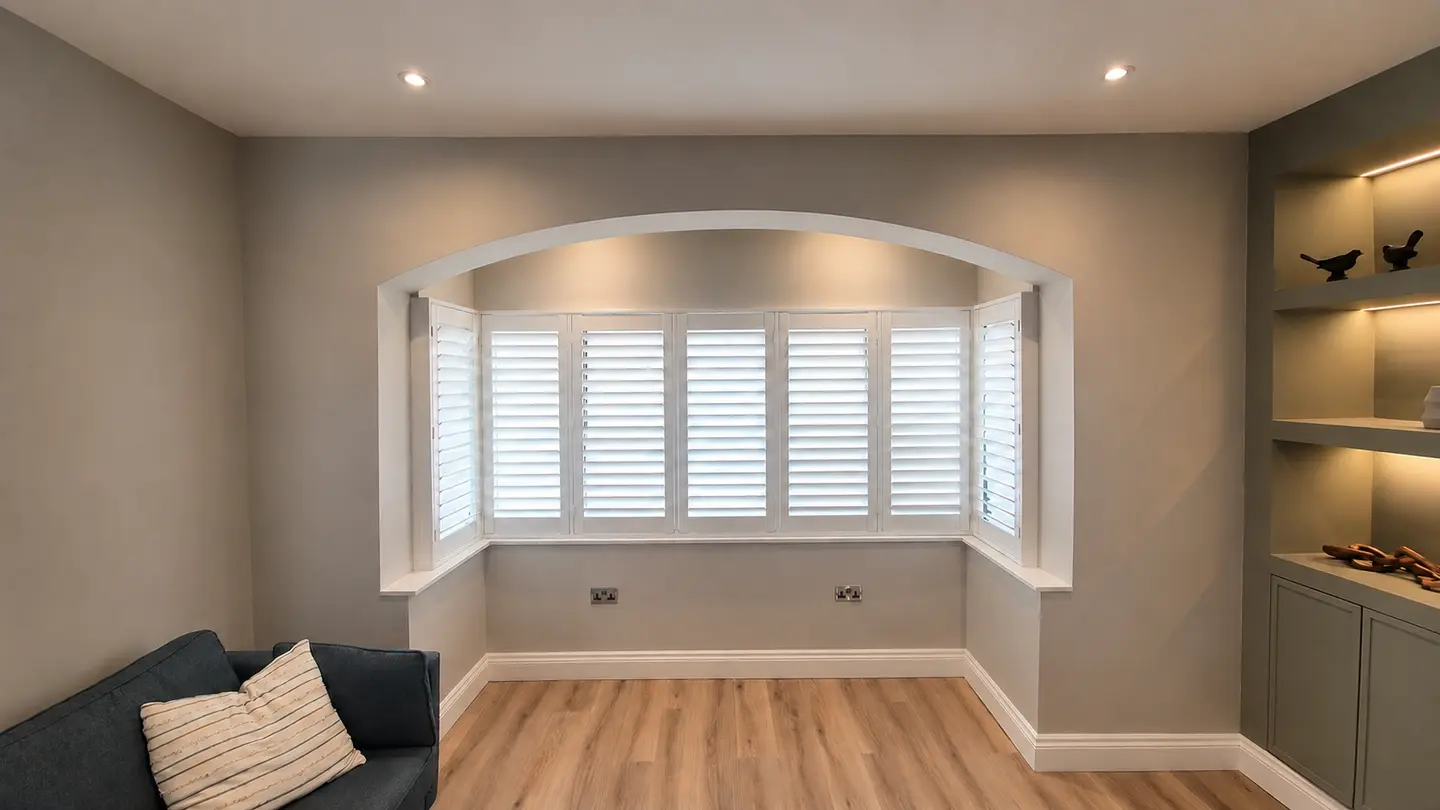
Reception rooms are usually the one space where homeowners want the shutters to be seen as much as usede, a bay window dressed in full-height shutters is often the first thing visitors notice. Grain and character matter here more than anywhere else in the house, which is why hardwood remains the most requested material for living rooms, particularly in the Edwardian and Victorian bay-fronted homes common across Kingston, Wimbledon and Richmond.
Recommended Material Hardwood
For character and depth of grain in formal rooms; Polycomposite where the room faces directly onto a busy street and the priority shifts to low maintenance over decades rather than natural finish.
Tier-on-tier configurations work well in reception rooms because they solve two problems at once: privacy from the pavement below without losing light from the top of the window. For a wide bay, full-height panels with a centred opening keep the sightlines clean rather than crowding the frame with too many narrow sections.
Kitchen Shutters
Kitchens are the room where the wrong material choice shows up fastest. Grease, steam and daily wiping down are constant, and a hardwood shutter above the sink or behind the hob will show wear within a couple of years that a Polycomposite shutter simply won't.
Recommended Material Polycomposite, without much debate.
It won't warp, swell or discolour from steam, and it wipes clean with a damp cloth rather than needing careful, product-specific care.
Café-style shutters, covering only the lower half of the window, are worth considering over a sink or worktop, since they keep the room private at eye level from the garden or street while leaving the top of the window uncovered for light and, where openable, ventilation. Full-height is still the better choice on larger kitchen windows or where the units sit below the sill line.
Bathroom and En-Suite Shutters
This is the one room in the house where material choice isn't really optional. A bathroom shutter deals with direct humidity, condensation and, in most UK bathrooms, very little natural ventilation to clear it quickly.
Recommended Material Polycomposite only.
It's 100% waterproof, won't absorb moisture into the panel core the way engineered wood products can, and holds its shape and colour regardless of how often the shower runs.
Frosted or obscured glazing changes the calculation slightly, where privacy is already handled by the glass, a café-style shutter can be enough, keeping the top of the window clear for extra light in what's often a small, windowless-feeling room. Where the glazing is clear, full-height is the safer choice.
Bedroom Shutters
Bedrooms are the room where light control matters more than anywhere else in the house, and the right answer depends heavily on which way the window faces. An east-facing bedroom catching direct morning sun needs a different approach to a north-facing room where the priority is closing out streetlight rather than daylight.
Recommended Material Hardwood
This is a genuinely good choice in bedrooms, since there's no moisture pressure working against it, and the natural finish tends to suit the softer, warmer feel most people want in a bedroom over the crisper look of Polycomposite.
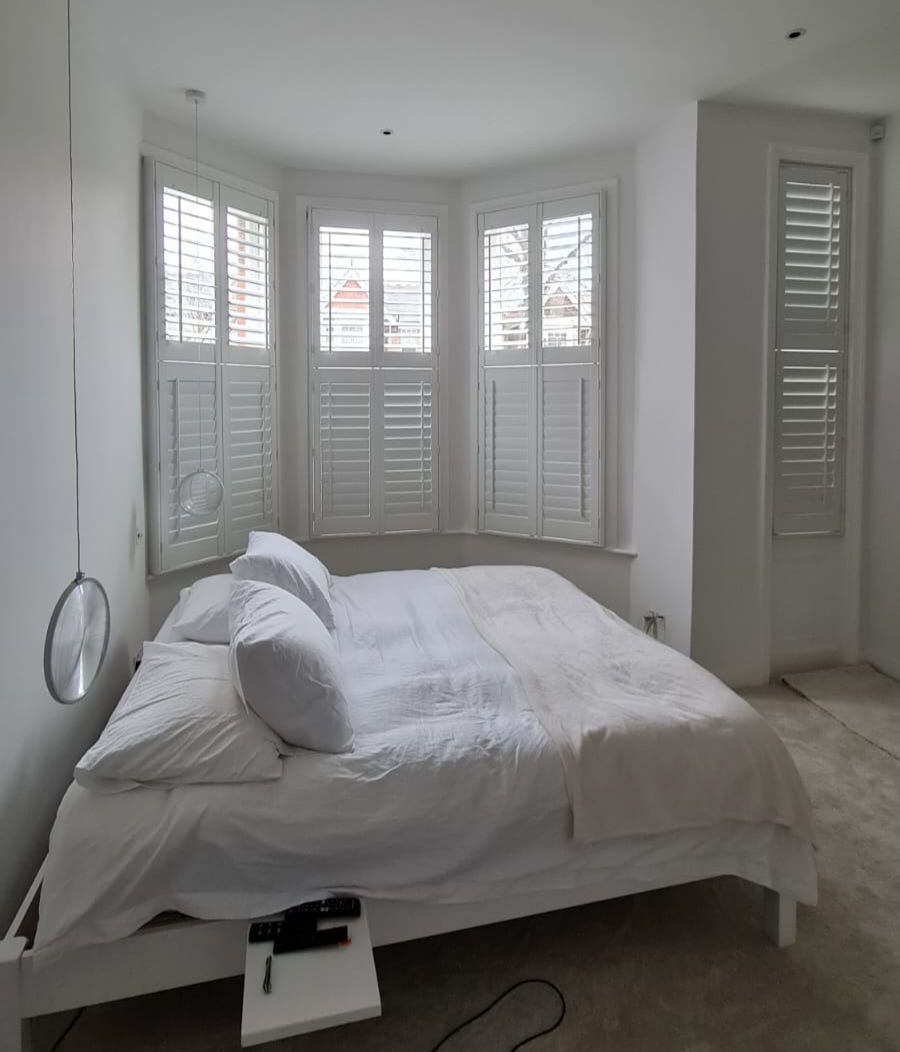
Tier-on-tier shutters is the most requested configuration for bedrooms specifically because it lets the top panel stay open for light and air while the bottom panel stays closed for privacy, genuinely useful in streets where bedroom windows face directly onto neighbouring houses, which describes a large share of the Victorian terraces across Wimbledon and Kingston.
Home Office and Study
The home office is a newer entry on this list, but it's one of the most common reasons for a shutter enquiry now. Screen glare and video call backgrounds are practical, everyday problems, and window shutters solve both more precisely than blinds or curtains.
Recommended Material Either hardwood or Polycomposite
Works well here, the choice usually comes down to the room's aspect rather than any functional requirement, since a home office rarely deals with the moisture or heavy wear of a kitchen or bathroom.
The main configuration decision is louvre size: narrower louvres give finer control over glare on a screen without needing to close the shutter fully, which matters more in a room used for hours at a time than it does in a living room or bedroom.
Bifold Doors, Patio Doors and Garden-Facing Rooms
Wide openings need a different approach entirely. A standard hinged panel doesn't work well across a three or four-metre bifold or sliding patio door, the panels need to track or fold cleanly to one side without obstructing the doorway when it's open.
Recommended Material
Polycomposite is generally the stronger choice here, since garden-facing glass gets more direct, sustained sun exposure than almost any other window in the house, and a stable, UV-resistant material holds its finish better over time under that exposure.
This is also where configuration matters more than material. Bi-fold panel systems and sliding tracks are specified to match the exact opening style of the doors, confirmed during the design consultation rather than guessed from a standard product range, which is precisely why garden-facing rooms in the newer developments around Kingston, Surbiton and Esher tend to need a site visit before any quote can be finalised.
Patio door and bifold shutter gallery
The Shutters Design 10-Year Free Aftercare Promise
Every installation from the Shutters Design team comes with ten years of free aftercare, not just a product warranty covering manufacturing faults, but ongoing support for the shutters themselves. Hinges loosen, tilt rods need the occasional adjustment, and normal daily use eventually calls for a minor tweak. All of that is covered, at no charge, for a decade from the day of installation.
There are no subcontractors at any stage. The same team who carries out the design consultation and measures the windows is the team who fits the shutters and who answers the phone if anything needs adjusting afterwards. Every shutter is UK-manufactured, which keeps lead times to around three weeks rather than the two-to-three months that's common with imported ranges and, on average, customers save around £500 against the equivalent installation from a national chain, without giving up any of the guarantee coverage those chains advertise.
Plantation Shutters Across Kingston, Richmond, Wimbledon and Surrey
South West London and Surrey give the Shutters Design team an unusually wide range of window shapes to work with in a single week. Kingston Hill and Richmond's Edwardian villas bring tall sash windows and box bays that suit full-height hardwood in the reception rooms, then a material switch entirely for the kitchen extension at the back. Wimbledon and Merton's Victorian terraces are narrower and taller, good light, tighter privacy margins from the street, and bathrooms that were often added later with steam and moisture considerations the original house never had.
The riverside apartments around Kingston Bridge and Richmond's waterfront lean towards Polycomposite almost across the board: smaller rooms, more direct sun exposure through larger glazing, and residents who want shutters that need nothing beyond an occasional wipe. Further out towards Esher, Epsom and the wider Earlsfield area, larger detached homes and newer developments bring wider openings, bigger bay windows, and garden-facing bifold doors that need the panel and track configurations covered above. Whatever the postcode, the room-by-room logic in this guide holds, the property type simply decides which rooms need which answer first.
Book Your Free Design Consultation
Ready to see what works for your rooms? The Shutters Design team offers a free, no-obligation design consultation across Kingston, Richmond, Wimbledon and South West London, in your home, with samples of every material in hand. Call 07776123386 or book a virtual consultation online. Every survey is followed by a clear, itemised quote with no hidden costs, and every installation is backed by ten years of free aftercare.
Frequently Asked Questions
About Business
Q: Who installs the shutters — is any of it subcontracted? A: No. Every design consultation, survey and installation is carried out directly by the Shutters Design team, no subcontractors, at any stage.
Q: How long has Shutters Design been fitting shutters in South West London? A: Shutters Design is a family business built over more than fifteen years of hands-on experience in the plantation shutter industry, working across Kingston, Richmond, Wimbledon and Surrey.
Q: Are the shutters made in the UK? A: Yes. All shutters are UK-manufactured, which keeps lead times to around three weeks rather than the two-to-three months common with imported ranges.
Installation
Q: How long does a typical installation take? A: Most single-room installations are completed within half a day. A full-house project across six to eight windows typically takes one to two days, scheduled around your routine.
Q: Do I need to prepare the room before you arrive? A: Just clear access to the windows. The Shutters Design team brings dust sheets, handles any furniture that needs moving, and leaves the room clean.
Q: Can shutters be fitted to uPVC windows and conservatories? A: Yes, with the correct frame depth and fixing method, confirmed at your free design consultation.
Remove & Refit
Q: I'm having new windows fitted — can my existing shutters be taken down and refitted afterwards? A: This falls under our sister service. The Shutters Design team focuses on new installations; removal and refitting of existing shutters is handled specifically by shutterinstallation.co.uk, who can usually schedule around your window fitters' timeline.
Broken Louvre
Q: One of my existing shutters has a damaged or broken louvre, can this be fixed? A: Louvre repairs and replacements sit with our dedicated repairs specialist at shutterinstallation.co.uk, who can usually match and replace a single damaged louvre without needing to replace the full panel.
Maintenance
Q: How do I clean plantation shutters? A: A dry microfibre cloth or feather duster weekly is enough for most rooms. Polycomposite shutters in kitchens and bathrooms can be wiped with a lightly damp cloth whenever needed.
Q: Do hardwood shutters need repainting or re-staining over time? A: Not under normal conditions. The factory finish holds up well for many years; direct, prolonged strong sunlight is the main factor that can affect colour over the long term.
Tracking Shutters
Q: What are tracking shutters, and when would I need them? A: Tracking (sliding or bi-fold) systems let large shutter panels slide or fold to one side. They're used for very wide openings — bifold doors or room dividers — where a standard fixed hinge isn't practical.
Q: Do tracking systems need more maintenance than standard hinged shutters? A: No — an occasional check that the track is free of dust and debris is all that's typically needed.
Patio Door Shutters
Q: Can shutters be fitted to bifold and sliding patio doors? A: Yes. Panel configuration is matched to the door's opening style — bi-fold panels for bifold doors, sliding panels for sliding patio doors — specified at your design consultation.
Q: Will the shutters get in the way when the doors are fully open? A: No. The configuration is chosen specifically so the shutters clear the full width of the opening.
Aftercare
Q: What does the 10-year free aftercare actually cover? A: Adjustment of hinges, tilt rods and moving parts, and resolving any operational issue that develops under normal use — at no charge, for ten years from installation.
Q: Who do I contact if something needs adjusting? A: The same team who measured and installed your shutters. Call 07776123386 — there's no call centre or ticketing system in between.